GNOME Disks Benchmark Tapers Off
I've recently been using GNOME Disks to benchmark some hard disks connected via a USB-SATA adaptor. It was getting results like this:
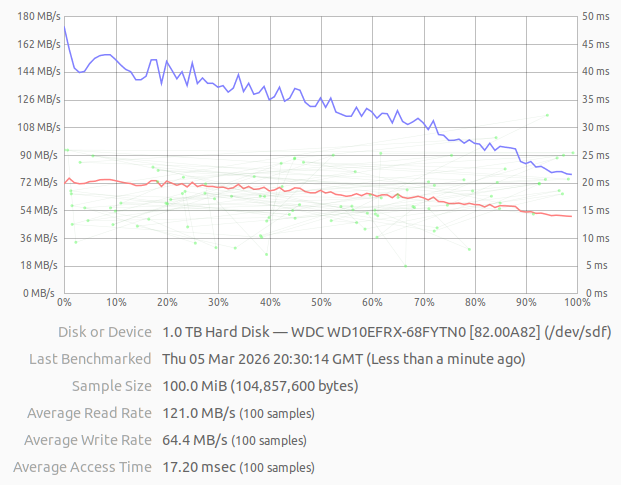
It would start off about where I expected and then slowly taper off to about half. Messing with the benchmark settings made no difference, the graph always had the same shape.
Switching to test via dd showed a steady 150MB/s:
dd if=/dev/sdf of=/dev/null bs=1M count=1024 status=progress
1073741824 bytes (1.1 GB, 1.0 GiB) copied, 7.26574 s, 148 MB/s

dd if=/dev/sdf of=/dev/null bs=1M count=10024 status=progress
2700083200 bytes (2.7 GB, 2.5 GiB) copied, 18.1619 s, 149 MB/s

dd if=/dev/sdf of=/dev/null bs=10M count=1024 status=progress
10737418240 bytes (11 GB, 10 GiB) copied, 71.5707 s, 150 MB/s
So what gives? Well, I'd assumed the x-axis was progress, it's not. It's the position on the disk which is being written/read. I did think it was odd how the latency plot would skip wildly back and forth rather than neatly from left-to-right.
Another thing that confirms this is that I noticed I could hear the disk physically seeking more often as it approached the end of the test. Seems I'm not the only one confused by this
Ok, But Why Is The End Of The Disk Slower?
It's caused by a combination of two things.
Firstly. A hard disk is split up into tracks, each track is a ring of sectors. The tracks on the outside of the disk are physically larger and have more sectors per track than the inside. This is called Zone Bit Recording.
Secondly. All tracks complete one revolution in the same amount of time, but the outer tracks have a larger circumference and so the head passes over them much faster.
These two things together mean that reading/writing to the start of a disk is much faster than the end. If I'd run the
dd test for long enough I would've seen the same effect.